First Aid/CPR/AED participant manuals, often available as PDFs, provide crucial guidance for emergency response;
These resources, like the American Red Cross manual, detail essential skills and protocols for various scenarios.
Updated versions, such as the December 2021 instructor’s manual, ensure alignment with current best practices and standards.
What is a First Aid/CPR/AED Participant Manual?
A First Aid/CPR/AED Participant Manual is a comprehensive resource designed to accompany formal training courses. Typically available in PDF format for easy access, these manuals serve as a vital study aid and reference guide for individuals learning life-saving techniques.
These manuals, such as those offered by the American Red Cross, detail procedures for handling various medical emergencies, from minor cuts and burns to life-threatening situations like cardiac arrest. They cover essential skills like CPR (Cardiopulmonary Resuscitation), AED (Automated External Defibrillator) operation, and basic first aid principles.
The content within these manuals reflects current standards of emergency care, regularly updated to incorporate the latest research and best practices. They often include illustrations, step-by-step instructions, and practical exercises to reinforce learning. Resources like the “Adult and Pediatric First Aid/CPR/AED Direct Links Resource Guide” further enhance understanding and skill development.
Importance of Certification and Training
While a First Aid/CPR/AED participant manual PDF provides valuable information, it’s crucial to understand that it’s not a substitute for formal certification and hands-on training. Certification courses, like those offered by the American Red Cross and utilized in NREMT study guides, ensure competency in performing life-saving skills.
Proper training equips individuals with the confidence and practical ability to respond effectively in emergency situations. It goes beyond simply reading procedures; it involves practicing techniques under the guidance of a certified instructor.
Certification demonstrates a commitment to preparedness and adherence to recognized standards of care. Employers often require certification for roles involving public safety or healthcare. Regularly updating certifications—as emergency protocols evolve—is vital, ensuring skills remain current and effective. The instructor’s manual emphasizes staying informed of changes in emergency care.
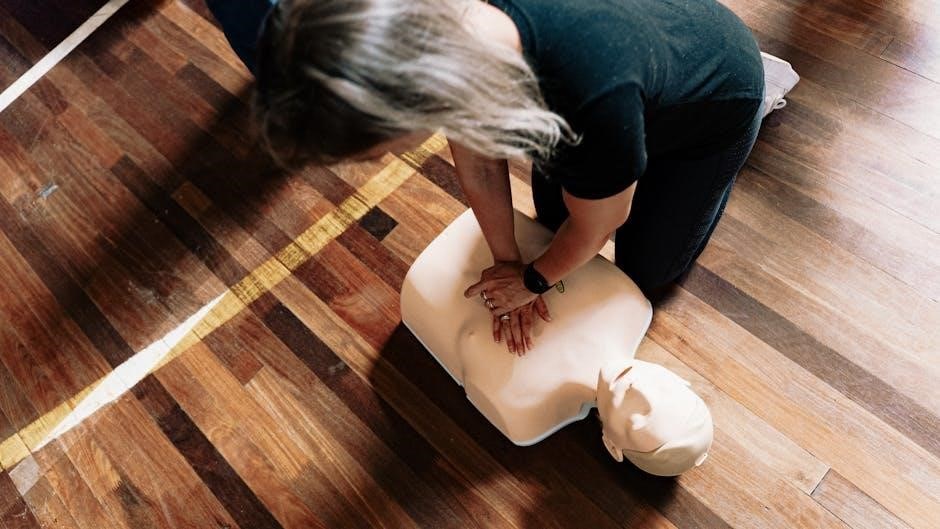
Basic Life Support (BLS)
BLS training, detailed in First Aid/CPR/AED manuals, focuses on interventions for breathing and cardiac emergencies, providing essential life-sustaining techniques.
Recognizing Cardiac Arrest
Cardiac arrest, a sudden loss of heart function, demands immediate recognition and action, as detailed within First Aid/CPR/AED participant manuals. These resources emphasize identifying key signs, including unresponsiveness – the individual doesn’t respond to stimuli.
Crucially, the absence of normal breathing, or only gasping, is a critical indicator. The manuals stress checking for a pulse, though this can be difficult for untrained individuals; prioritizing chest compressions is paramount if unsure.
Prompt recognition, guided by the procedures outlined in these manuals, is vital because every minute without CPR and defibrillation significantly decreases the chance of survival. Understanding these indicators empowers individuals to initiate life-saving interventions swiftly and effectively, potentially bridging the gap until professional medical help arrives.
CPR Steps for Adults
CPR for adults, as detailed in First Aid/CPR/AED manuals, begins with ensuring scene safety and checking for responsiveness. If unresponsive, immediately call emergency services or delegate someone to do so.
Begin chest compressions: place the heel of one hand in the center of the chest, with the other hand on top, and compress at a rate of 100-120 compressions per minute, to a depth of at least 2 inches.
After every 30 compressions, deliver two rescue breaths, ensuring the chest rises. Continue this cycle until professional help arrives or the individual shows signs of life. These manuals emphasize uninterrupted compressions, minimizing interruptions for breaths, and proper hand placement for effective circulation.
CPR Steps for Children and Infants
First Aid/CPR/AED participant manuals outline specific techniques for children and infants. For children, use one or two hands for chest compressions, depending on the child’s size, compressing about 2 inches deep. The compression rate remains 100-120 per minute.
For infants, use two fingers (or two thumbs encircling the chest) for compressions, about 1.5 inches deep. Rescue breaths are gentler, covering the infant’s mouth and nose with your mouth.
The compression-to-breath ratio is typically 30:2 for both, but manuals may detail variations for single rescuers. Continuous, high-quality compressions are vital, and prompt emergency medical services activation is crucial in both scenarios.

Automated External Defibrillator (AED)
First Aid/CPR/AED manuals detail AED operation, emphasizing safety and proper pad placement.
These guides explain how AEDs analyze heart rhythms and deliver shocks when needed, potentially saving lives.
How an AED Works
Automated External Defibrillators (AEDs) are vital tools designed to analyze the heart’s rhythm and deliver an electrical shock if necessary, restoring a normal heartbeat. First Aid/CPR/AED participant manuals comprehensively explain this process.
The AED uses adhesive electrodes placed on the chest to detect electrical activity. It differentiates between shockable rhythms – ventricular fibrillation and pulseless ventricular tachycardia – and non-shockable rhythms. If a shockable rhythm is identified, the AED will advise a shock.
Crucially, the device guides the user through each step with voice prompts and visual indicators, ensuring proper operation even for those with limited training. Manuals emphasize that AEDs are designed to be user-friendly and safe, minimizing the risk of delivering an inappropriate shock. The energy delivered is carefully calibrated to maximize effectiveness while protecting the patient.

AED Safety Precautions
First Aid/CPR/AED participant manuals prioritize safety when using an Automated External Defibrillator (AED). Several precautions are essential to protect both the rescuer and the victim.
Before applying the AED, ensure the victim is lying supine on a firm, dry surface. Remove any water from the chest. Avoid direct contact with the victim during shock delivery – verbally announce “Clear!” before pressing the shock button, ensuring no one is touching the patient.
Do not use an AED on a victim who is wet, in a puddle, or lying in water. Remove any transdermal patches before applying the pads. Avoid placing pads directly over implanted devices like pacemakers or defibrillators; position them adjacent to such devices. Manuals stress continuous CPR until the AED is ready and after each shock, if no immediate signs of life return.
Steps for Using an AED
First Aid/CPR/AED participant manuals outline a clear sequence for AED operation. First, power on the AED; it provides voice prompts guiding the user. Next, expose the victim’s chest and attach the AED pads as illustrated on the pads themselves – one on the upper right chest and the other on the lower left side.
The AED analyzes the heart rhythm. Ensure no one is touching the victim during analysis. If a shock is advised, the AED will charge. Verbally announce “Clear!” before pressing the shock button. After delivering the shock, or if no shock is advised, immediately resume CPR, starting with chest compressions.

Continue following the AED’s prompts, alternating between analysis and CPR, until emergency medical services arrive and take over. Manuals emphasize consistent, uninterrupted care.

Common First Aid Scenarios
First Aid/CPR/AED manuals cover essential responses to cuts, wounds, burns, and choking emergencies, providing step-by-step guidance for effective care.
Dealing with Cuts and Wounds
First Aid/CPR/AED participant manuals emphasize a systematic approach to managing cuts and wounds, beginning with ensuring scene safety and utilizing personal protective equipment.
Initial steps involve controlling bleeding through direct pressure, elevation, and, if necessary, pressure bandages.
Manuals detail how to assess wound depth and severity, differentiating between minor abrasions and more serious lacerations requiring professional medical attention.
Cleaning the wound thoroughly with soap and water is paramount, followed by applying an antiseptic solution to prevent infection.
The importance of proper wound dressing and bandaging is highlighted, alongside recognizing signs of infection – increased pain, redness, swelling, or pus – that necessitate immediate medical evaluation.
These manuals provide clear, concise instructions for effective wound care, empowering individuals to provide crucial first aid until professional help arrives.
Responding to Burns
First Aid/CPR/AED participant manuals provide detailed guidance on responding to burns, categorizing them by severity – first, second, and third-degree – to determine appropriate care.
For minor burns, the primary focus is cooling the affected area with cool (not cold) running water for at least 10-20 minutes.
Manuals advise against applying ice, butter, or other home remedies, as these can worsen the burn.
Covering the burn with a sterile, non-adhesive dressing is crucial to prevent infection.
Severe burns require immediate medical attention; manuals emphasize the importance of calling emergency services and monitoring the victim for signs of shock.
Do not attempt to remove clothing stuck to the burn. These resources equip individuals with the knowledge to provide effective burn first aid, minimizing damage and promoting healing.
Choking – Adult, Child, and Infant
First Aid/CPR/AED participant manuals dedicate significant sections to choking emergencies, recognizing the distinct approaches needed for adults, children, and infants.
For conscious adults and children, the Heimlich maneuver is the recommended technique, involving abdominal thrusts to dislodge the obstruction;
Manuals provide clear diagrams and step-by-step instructions for proper hand placement and execution.
Infant choking requires a different approach: alternating five back blows with five chest thrusts.
If the victim becomes unconscious, manuals instruct to carefully lower them to the ground and begin CPR, checking for the object in the mouth before each set of compressions.
These guides emphasize quick recognition of choking signs and prompt intervention to prevent brain damage or death.

Emergency Situations & Protocols
First Aid/CPR/AED manuals outline protocols for critical emergencies like heart attacks, strokes, and anaphylaxis, emphasizing rapid assessment and response.
They detail symptom recognition and initial care steps before professional help arrives.
Recognizing and Responding to Heart Attack Symptoms
First Aid/CPR/AED participant manuals emphasize prompt recognition of heart attack symptoms, which can vary but often include chest discomfort, pain radiating to the arm or jaw, shortness of breath, nausea, and cold sweats.
Immediate action is critical. The manuals instruct individuals to call emergency services (911 in the US) immediately and to have the person sit down, rest, and loosen any tight clothing.
If the individual is conscious and alert, and has been prescribed nitroglycerin, assist them in taking it as directed.
CPR may be necessary if the person becomes unresponsive and stops breathing normally; the manual provides detailed CPR steps.
An AED should be used as soon as possible if available, following the device’s prompts.
These manuals stress that time is of the essence and quick, informed action can significantly improve outcomes.
Stroke Identification and First Aid
First Aid/CPR/AED participant manuals highlight the importance of rapid stroke identification using the “FAST” acronym: Face drooping, Arm weakness, Speech difficulty, and Time to call 911.
These manuals detail that a stroke occurs when blood supply to the brain is interrupted. Quick response is vital to minimize brain damage.
First aid involves immediately calling emergency services and noting the time symptoms began, as this information is crucial for medical professionals.
Keep the person calm and comfortable, and monitor their breathing and level of consciousness.
Do not give them anything to eat or drink.
The manuals emphasize that strokes require immediate medical attention and that attempting self-treatment is dangerous; professional care is paramount.
Dealing with Allergic Reactions (Anaphylaxis)
First Aid/CPR/AED participant manuals emphasize recognizing anaphylaxis – a severe, potentially life-threatening allergic reaction. Symptoms include hives, swelling, difficulty breathing, and a drop in blood pressure.
The primary first aid step is to use an epinephrine auto-injector (EpiPen) if available, following the instructions provided with the device.
Immediately call emergency services (911) even after administering epinephrine, as a second wave of symptoms can occur.
Keep the person lying flat with their legs elevated, unless they are having trouble breathing, in which case they should sit up.
Monitor their breathing and be prepared to administer CPR if necessary.
Manuals stress the importance of knowing the individual’s allergy history and having an action plan in place.

Resources and Further Learning
First Aid/CPR/AED resources include American Red Cross programs, NREMT study guides, and accessible online manuals in PDF format for continued education.
American Red Cross First Aid/CPR/AED Programs
The American Red Cross offers comprehensive First Aid/CPR/AED programs designed to equip individuals with life-saving skills. These programs utilize detailed participant manuals, frequently available as downloadable PDFs, covering essential techniques for emergency situations.
These manuals, updated periodically – like the Instructor’s Manual from December 2021 – reflect current standards and best practices in emergency care. The Red Cross provides courses for various levels, from basic first aid to advanced life support, catering to diverse needs, including babysitter training.
Participants gain hands-on experience and knowledge regarding recognizing emergencies, performing CPR, utilizing an AED, and managing common injuries like cuts, burns, and choking. Accessing the First Aid/CPR/AED participant manual PDF allows for convenient review and reinforcement of learned skills, ensuring preparedness when every second counts. Visit redcross.org for more information.
NREMT Study Guides and Materials
For those pursuing National Registry of Emergency Medical Technicians (NREMT) certification, supplemental study guides are invaluable. While a dedicated First Aid/CPR/AED participant manual PDF isn’t solely focused on NREMT preparation, understanding the core concepts within these manuals is fundamental.
Resources like the “Study Guide NREMT” (PDF, 40 pages) complement broader EMT training. These guides often integrate First Aid/CPR/AED principles as foundational elements of emergency medical care. Mastering skills detailed in Red Cross manuals – recognizing cardiac arrest, performing effective CPR, and utilizing an AED – directly translates to NREMT exam success.
Combining official NREMT materials with practical knowledge from First Aid/CPR/AED resources ensures a well-rounded understanding of emergency response protocols. Thorough preparation, utilizing both types of materials, is key to achieving certification.
Accessing Online First Aid/CPR/AED Manuals (PDF)
Numerous online resources offer First Aid/CPR/AED manuals in PDF format, providing convenient access to vital information. Direct links are available for participant manuals, encompassing adult and pediatric care, and resources for BLS and lifeguarding programs. The American Red Cross is a primary source, offering comprehensive guides for download.
Searching for “First Aid-CPR-AED Participants Manual.pdf” yields various results, including versions updated as recently as December 2021. Websites archive older editions alongside current materials, offering a historical perspective on evolving emergency care practices.
Ensure downloaded PDFs originate from reputable sources like the Red Cross to guarantee accuracy and adherence to current guidelines. These digital manuals are invaluable for review, training, and quick reference in emergency situations.